

By: Jessica Park
As countries around the world work to rebuild public trust in vaccines after the COVID-19 pandemic, Vietnam stands out, not because it made Covid vaccines mandatory for children, but because of how it responded to public hesitation. When the Vietnamese government considered mandating Covid-19 vaccines, many parents resisted, fearing side effects and spreading rumors of expired doses.
Their skepticism shaped policy—the Covid vaccine mandate never happened in Vietnam. And it led to greater caution. More parents started scrutinizing packaging to ensure that every vaccine jabbed into an arm came from a reputable company. What Vietnam’s Covid concerns did not do was evolve into a broader anti-vaccine movement, as it is currently being observed in the United States. Instead, Vietnam’s concerns about Covid revived gratitude for routine vaccination. In 2024 coverage for the first dose of the measles vaccine in Vietnam reached 98 percent, and the vaccine for polio reached 99 percent.
“There was a scare, and that’s why there was an almost global commitment to say, ‘We will now work toward making a more robust system,’” said Basil Rodrigues, UNICEF’s Regional Health Adviser for East Asia and the Pacific. “Countries are trying to ensure that they strengthen their vaccine systems.”
Vietnam is not alone. Brazil, Nigeria, Hungary, and Samoa are among several countries investing more in vaccination to try to catch up after Covid, during a global rise in outbreaks of measles and yellow fever.
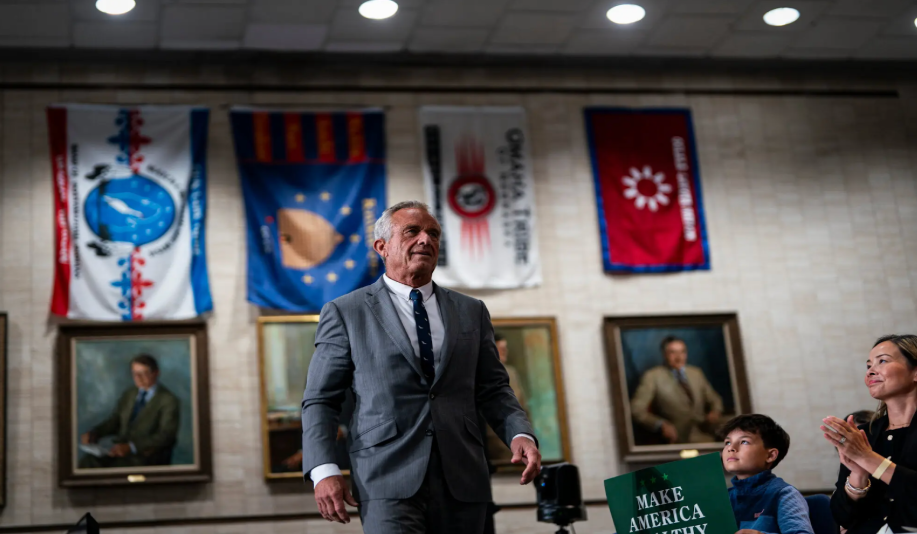
By contrast, the United States has a drastically different path. It remains an outlier, not because of public opinion, which still largely supports vaccination, but because of government policy, according to experts. Health Secretary Robert F. Kennedy Jr., shown in the picture above, and other vaccine critics are now in charge of public health, and—under the banner of MAHA, or “Making America Healthy Again”—they are stripping away support for vaccine development, promotion, and distribution.
Florida recently became the first U.S. state to eliminate vaccine mandates. Experts warn that it weakens a public health policy designed to ensure that—in a decentralized and unequal health care system—nearly every child could be protected from potentially deadly infections. In addition, Health Secretary Robert F. Kennedy has defunded vaccine research. He has replaced vaccine experts with critics on a key advisory panel, limited access to Covid shots, and muddied official guidance on many others, worrying experts who see confusion eroding vaccine confidence worldwide. As Heidi J. Larson, who leads the Vaccine Confidence Project at the London School of Hygiene and Tropical Medicine, recently put it in an essay for The Lancet, “The U.S.A., long a cornerstone of global health leadership, has become an unexpected source of global instability in vaccination confidence.”
The Department of Health and Human Services, responding to such critiques from experts, said in an email that Mr. Kennedy was simply “being honest and straightforward about what we know—and what we don’t know—about medical products, including vaccines.” But scientists see the situation differently. They argued that scientific facts are disregarded, with effects that could last for years. “The threat is this: that the U.S.-style anti-vax movement linked to MAHA wellness-influencer grifting and authoritarianism is now globalizing,” said Peter J. Hotez, a vaccine expert at Baylor College of Medicine.
On September 10, 2025, vaccine advisers to the U.S. Centers for Disease Control and Prevention voted unanimously to shift away from a broad recommendation for Covid-19 vaccines to say that people who want one must consult with a health care provider, a process known as shared clinical decision-making. However, the Advisory Committee on Immunization Practices was split on whether to recommend that a prescription for a Covid-19 vaccine should be required. That vote was 6-6; Dr. Martin Kulldorff, the chair of the committee, voted no, which broke the tie.
The committee now says people 65 and older should make the decision about whether to get a Covid-19 vaccine with a doctor or another health care provider. It should be the same for people ages 6 months to 64 years, the vaccine advisers voted, but with “an emphasis that the risk-benefit of vaccination is most favorable for individuals who are at an increased risk for severe COVID-19 disease and lowest for individuals who are not at an increased risk, according to the CDC list of COVID-19 risk factors.”
The recommendations are not final and remain subject to change. They now await approval from Acting CDC Director Jim O’Neill, a deputy of the Health Secretary, since Dr. Susan Monarez was removed abruptly last month.