

By: Jessica A. Dennehy
It’s not every day that a fictional K-pop group beats Blackpink to become the highest-charting female K-pop act of all time. It’s also not every day that another fictional K-pop group—from the same movie—outpaces BTS for the male equivalent. Yet Netflix’s K-Pop Demon Hunters has managed to do exactly that, in less than three months. The soundtrack has become a phenomenon: the album topped the Billboard 200, while Huntr/x’s anthem “Golden” hit No. 1 on the Global 200 and has sat (non-consecutively) at No. 1 on the Billboard Hot 100. It’s become the first soundtrack in the 67-year history of the Hot 100 to chart four songs in the top 10 simultaneously. Additionally, it’s the fifth soundtrack in history to generate four top 10s at all—and the first since 1995’s Waiting to Exhale. It’s also the first soundtrack since Saturday Night Fever (1978) to land three songs in the Hot 100’s top five.
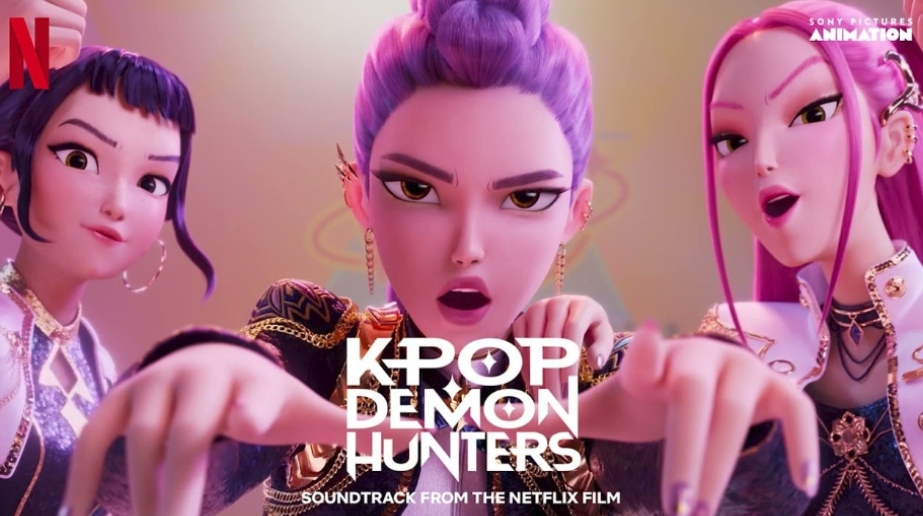
K-Pop Demon Hunters, a Sony film released on Netflix, follows Rumi, Zoey, and Mira, three girls who form the K-Pop girl group Huntr/x. They spend their days selling out stadiums and their nights hunting demons, keeping the public safe. As they navigate the difficulties of keeping their secrets, they encounter a rival boy band, the Saja Boys. The group, led by Jinu, go out of their way to dethrone both worlds, being secretly demons. This film has something for everyone: emotional clarity, a nuanced storyline, and, of course, an absolute bop of a soundtrack.
How It’s Done – Huntr/x
The film opens up with Huntr/x performing this song. As they culminate their world tour and casually thwart the demons who are trying to stop them, this EDM-inspired piece sets a confident tone for the group. Paired with synth instrumentals, strong vocals, and a stunning high note, the song, from a musical lens, is impressive coming from a kids movie. Animators actually commented that they had to sync the fight scene (in which the song takes place) to the music. With a combination of rapping and belting, the track is very reminiscent of earlier Blackpink songs.
Golden – Huntr/x
Riding the highs of finishing their world tour, Huntr/x proceeds to release a new single. This is THE song for them, designed to be their story and to permanently seal the Honmoon. While still maintaining some of the synth elements of How It’s Done, Golden is far more intimate. The buildup to the chorus is powerful, with the vocals starting from a deep to insane high belting. The absolute range of the vocals isn’t something easily hit—even in the shower. The chorus itself is addictively raspy, something uncommon in K-pop, and just conveys the intimacy of the message of the song. A song with an ascending chorus, which nicely complements the lyrics, it’s understandable how it repeatedly topped the charts—both in the movie and in real life.
Soda Pop – The Saja Boys
This serves as the Saja Boys’ debut: an impressively catchy song with minimal substance. Actually utilizing the pouring, fizzling, and popping sounds from cracking open a can of soda, this is Huntr/x’s competition. Also containing its own rap section and various high notes, the superficial performance serves as a parallel to the girl group’s own songs. Even Chris Appelhans, one of the film’s directors, acknowledged this when comparing songs between the two groups. He explained that they “wanted the Saja Boys’ songs to be super catchy but slightly hollow, like there’s no real soul underneath,” so that when the audience contrasted them to the girl’s more emotional, vulnerable songs, “the surface-level part of your heart might be obsessed with the boys, but the deeper part is moved by the girls.” In short, this, for the Saja Boys, is a performance, a guise to take the hunters down.
Takedown – Huntr/x
Did a little foreshadowing there (hehehe), but Huntr/x are obviously enraged at the Saja Boy’s debut. As they compete for their fans and the corresponding power to release the demons from the underworld, the girls write an angry diss track vividly detailing how they are going to win. It has a very strong beat, containing an almost bouncy synth bassline. An incredibly angry song (as most diss tracks are), the vocals are far more raw relative to their other songs, almost just being yelled at times. Incorporating a lot of rapping portions, the build for the bridge and chorus sticks out as incredibly melodic. It’s interesting to note how, as a response to Soda Pop, a song disguising the Saja Boys’ true intentions, Takedown strips down any niceties from Huntr/x. I mean, they vividly describe how they’ll “cut you open, lose control, then rip out your heart.” It doesn’t get more hunter-esque than that.
Free – Rumi (from Huntr/x) and Jinu (from The Saja Boys)
So…if you haven’t watched the movie… A few steps were skipped from Takedown to Free. A ballad between the leaders of the respective groups, it’s very vocal-intensive. The introduction starts off very softly, with Rumi’s vocals being incredibly intimate. As the song builds—reflecting her growing confidence—she projects more, hitting hauntingly low notes. Something I found interesting was she phrases everything almost as a question, with a slight “up” on every line. As she attempts to convince Jinu to help out the hunters, the intimacy of the vocals makes it feel confessionary or even pleading. This ballad remains one-sided until maybe around halfway through the song, when Jinu finally joins her. Relative to Rumi’s portion, Jinu’s is harsher, having a faster cadence and concluding “downs” on every verse. This serves to convey his doubts regarding her offer, but eventually, Rumi sways him over. The duet finally occurs in the chorus, with Jinu’s vocals serving more as a complement to Rumi’s, with both hitting those “ups.” This time, however, it isn’t utilized as a question but rather to demonstrate their shared hope that Rumi’s plan will work. The pair start belting their hearts out through the bridge until the end. The ending is similar to the introduction: minimal instrumentals, a near-confessional vocal pair—but this time, the convincing is over. They are in agreement; they are in harmony.
Your Idol – The Saja Boys
This is a movie, however, so obviously whatever was going on earlier is out the door for this straight BANGER. Like, the moment was cute and stuff, but hello, when you start a song with a Latin choir, who cares about the power of friendship? Huntr/x has lost the Idol Awards, the demon hunters are at each other’s throats, and it seems that the Saja Boys have won. This song is what Golden was to Huntr/x: Golden was the final song to seal the Golden Honmoon; Your Idol is the final song needed to destroy it. And the combination of high notes, beat drops, and heavy rap influence is just cloyingly addictive. In this portion of the story, there are additionally some lyrical mirrors between prior Huntr/x songs and Your Idol:
“’Cause I see your real face, and it’s ugly as sin.” (Takedown) vs. “I’m the only one who’ll love your sins.” (Your Idol); “We can’t fix it if we never face it / Let the past be the past ’til it’s weightless.” (Free) vs. “Don’t let it show, keep it all inside / The pain and the shame, keep it out of sight” (Your Idol); and even the directional element of their biggest hits: Golden’s “We’re goin’ up, up, up / It’s our moment” vs. Your Idol’s “You’re down on your knees, I’ma be your idol.”
It was fascinating to see the casual references to Huntr/x even when the Saja Boys had obviously won. The snide pettiness of the Saja Boys was an interesting addition to their attempt to destroy the world on behalf of Gwi-Ma, the demon king.
What It Sounds Like – Huntr/x
Going back to my earlier point—this is still a movie! Letting the Saja Boys have the last song is just not something that can happen. Rumi reunites with Zoey and Mira, apologizing for not being honest with them. They make up, undergo a magical outfit change (so the power of friendship did come into play…), and start killing demons en masse. The introduction has no background instrumental whatsoever: this is Rumi’s isolated apology. The backing track only comes into play once the girls are reunited and the group is reformed. It builds slowly, still maintaining that raspy vocal element from prior songs. Also from prior songs, the melody of Golden can actually be found in this song’s chorus, reflecting the execution of Golden’s original purpose. This is the group’s more bare performance, where after they defeat the demons, they learn to accept who each other are…in their entirety.
The People Behind These Chart-Topping Hits
The original songs from the K-pop Demon Hunters soundtrack were written by a myriad of individuals: Danny Chung, Ido, Vince, Kush, Ejae, Jenna Andrews, Stephen Kirk, Lindgren, Mark Sonnenblick, and Daniel Rojas; and produced by Teddy Park, 24, Ido, Dominsuk, Andrews, Kirk, Lindgren, and Ian Eisendrath. The vocals for the songs were sung by Ejae (Rumi), Audrey Nuna (Mira), Rei Ami (Zoey), Andrew Choi (Jinu), Kevin Woo (Mystery), samUIL Lee (Romance), Neckwav (Abby), Danny Chung (Baby), and Lea Salonga (Celine). Additionally, a rendition of the album’s lead single, Takedown, was performed by Jeongyeon, Jihyo, and Chaeyoung of the girl group Twice.