

By: Snigdha Chakravarti
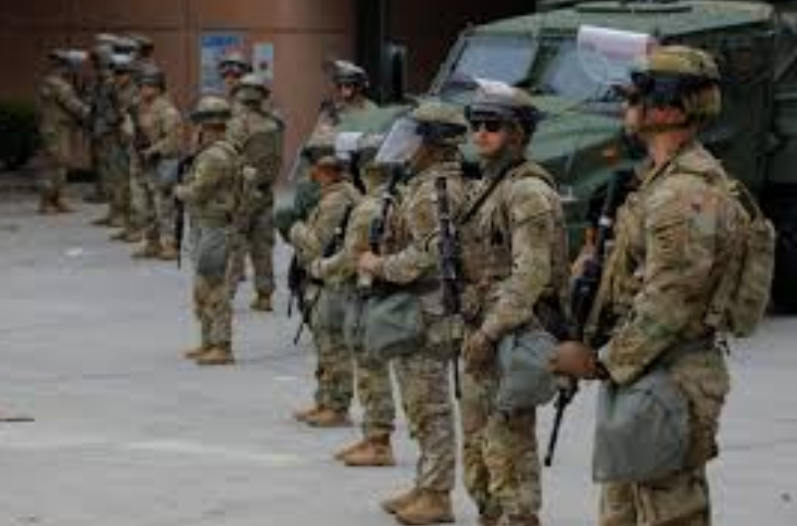
In early June of this year, President Trump made yet another move that shocked the democratic walls of this nation: the deployment of National Guard troops to Los Angeles, California. Though the President claimed that he used the National Guard to “crack down” on crime and enforce immigration, many in the city felt that his action was a federal overreach of power.
A few days after the troops were deployed, California Governor Gavin Newsom filed a lawsuit against the Trump administration for unlawfully stationing the National Guard in the city without the state’s consent; the case ruled against Trump this past September. The case isn’t closed completely, though, as the President’s actions may hold implications in the near future.
According to US District Judge Charles Breyer, who was in charge of the case filed by Newsom against Trump, Trump’s use of the National Guard in LA violated the Posse Comitatus Act. This law holds that the use of federal power through military force in states’ affairs is limited. Essentially, federal troops cannot be used to enforce specific domestic laws; however, this comes with the exception of authorization through Congress, a circumstance that would legalize such federal involvement.
The Trump administration, though, did not gain permission from Congress, therefore illegally “setting up protective perimeters, traffic blockades, and crowd control” and “engaging in arrests, apprehensions, searches, seizures, security patrols, traffic control, crowd control, riot control, evidence collection, interrogation, or acting as informants,” as stated by Judge Breyer. The President, on the other hand, believed that California Governor Gavin Newsom was “very weak” and needed the federal government’s help, especially after violent protests against his [Trump’s] immigration policies.
The President went on to mention that sending the National Guard was necessary to protect the federal property and residents living there.
Governor Gavin Newsom was supportive of Judge Breyer’s decision, stating that “the court sided with democracy and the Constitution” after the President circumvented Newsom’s authority in order to deploy the National Guard. On August 5th, the federal government extended the troops’ presence in California until the redistricting special election in November, causing Newsom to believe that the Trump administration wanted “to continue their intimidation tactics” to sway Californians to their side. Moreover, Newsom saw Trump’s action as a “trampling of a state’s power to protect its people,” once again pointing at the undemocratic nature of deploying the troops.
Critics of Judge Breyer’s decision include White House spokeswoman Anna Kelly. Kelly called him a “rogue judge” who was attempting “to usurp the authority of the commander-in-chief to protect American cities from violence and destruction.” This emphasizes the President’s claim that sending the National Guard was a protective measure to reinforce immigration measures and combat crime. Unlike Newsom’s view of a political motive to send the troops, Kelly sees the President’s concern for the welfare of the people in LA as the motive.
Likewise, Justice Department Attorney Eric Hamilton believed that the National Guard was simply a protective measure, thus not violating the Posse Comitatus Act. In addition, Major General Scott Sherman (commander of the National Guard) expressed how the National Guard could conduct security patrols and interfere in traffic, crowds, and riot control in order to protect local residents and federal property since “it was in line with what the President was directing.” Sherman’s view portrays the President’s own belief of having unchecked powers to perform actions like this.
President Trump further wishes to send National Guard troops to other cities, in part to establish “a national police force with the President as its chief,” according to Judge Breyer. Breyer’s concern is a concern for many, and moreover, to an extent that the definition of democracy in the US is being questioned.