

By Brian Ni
With the recent protests in Minneapolis, we should reflect on the facts of some of the events that have led people to protest ICE and federal officials in handling the immigration issue.
Renee Nicole Good
On January 7th, 2026, a mother of three children and a US citizen, Ms. Renee Good was at the scene of an ICE raid with whistles and was shot 3 times: once in the left forearm, once in the right breast, and a fatal shot in her left temple–killing her. Prior to her getting shot, she was confronted by ICE agents in her car, including Jonathan Ross who inevitably kills her, and was commanded by the agents to get out of the car. Whilst attempting to flee from the agents in her car, one of Renee Good’s last words on tape, “That’s fine, dude. I’m not mad at you”, and her status as a US citizen galvanized the people in Minneapolis to protest ICE.
Alex Pretti
On January 24th, 2026, an ICU nurse for veterans and a US citizen with the right to carry in an open-carry state, Mr. Alex Pretti, was using his 1st amendment rights in recording his encounter with border patrol agents until they pushed a lady to the ground. Pretti attempted to help the lady up, however, the agents pulled out pepper spray and started macing the pair. Then, while Pretti was still helping the lady, the border patrol agents ripped him away and dragged him to the ground, with 8 agents holding Pretti down. Now on the ground, Pretti held his hands above his head while getting beaten by the agents, and he proceeded to get his gun seized by border patrol even though he had a right to carry it (the agents did not have an immediate suspicion on his possession of a firearm, as he never reached for it at anytime during the interaction). When his gun was getting taken away, a border patrol agent likely heard the phrase “gun!”, which resulted in him pulling out his sidearm and discharging a bullet into Pretti’s back. A couple agents further exacerbated the event by pulling out their firearms and shooting bullets into him, for a total of 10. One of his final words was “Are you okay?”, which he had asked to the lady that the border patrol agents originally pushed. His death resulted in further protests in Minneapolis because the agents had openly violated constitutional rights (1st Amendment rights, 2nd Amendment right, 4th Amendment right, and 14th Amendment rights) and had no repercussions until public pressure.
The Government’s Response
With both deaths, American citizens were able to be killed for merely ‘interfering’ in government activities, even if they were not interfering and were staying in their rights given in the Constitution. In both cases, the federal government, the executive branch in particular, highlighted both victims as ‘domestic terrorists’ and painted them as aggressors. While Renee Good’s death could be argued by both sides, Pretti’s death showed the neglect of the federal government for control and factual reporting, as the Department of Homeland Security (ICE and Border Patrol fall under this department) showed the attempting to justify their actions through painting Pretti as a violent person that pulled a gun out on federal officials and who was also trying to resist arrest. With the media actively depicting their moves during each interaction, the government effectively lied to the public and contradicted evidence provided through recordings in each case.
Minnesota activated the National Guard to help the police and protect against the ICE advances within the city of Minneapolis.
The Protests That Ensued
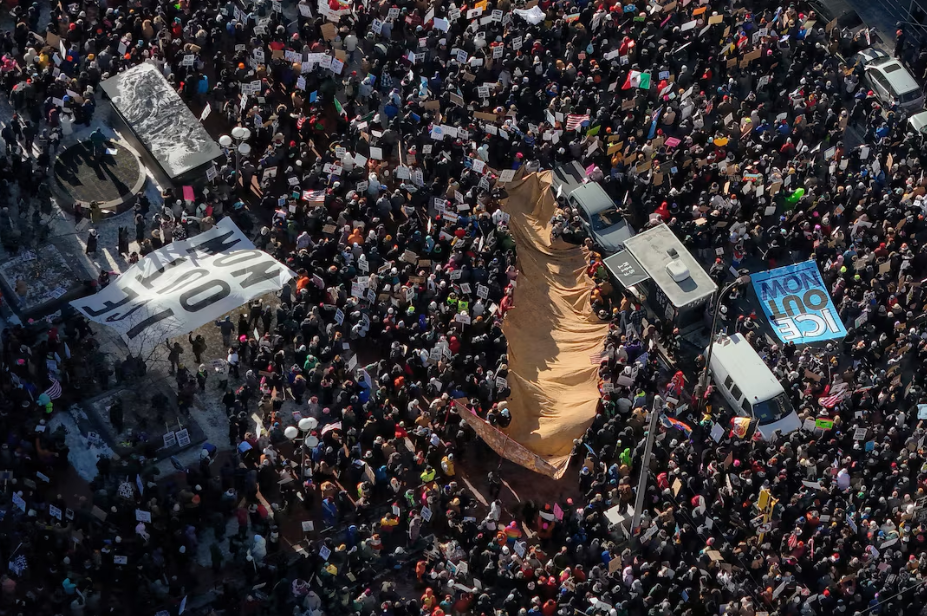
After Renee Good’s death, hundreds of businesses in Minneapolis closed and protesters boycotted companies that actively supported ICE.
After Alex Pretti’s death, protests across the US popped up to push ICE out of cities, further building on the effect Renee Good’s death brought, and brought ICE funding and government credibility into question.