

By Jessica A. Dennehy
For those planning on attending college next year, a pivotal date has just passed in the admissions process. November 1st marks the early deadline for the majority of secondary education institutions, with many students at Williamsville East having submitted applications to the schools of their choice. With this time of year comes a lot of excitement and anticipation, but for those uninformed, it can be hard to know what’s happening. So, for anyone eager to get in on the hype of college applications, here’s a crash course on the early application process.
Why Apply Early?
Simply put, applying early can increase your chances of getting in. It demonstrates strong interest in a particular school and places you in a smaller pool of applicants during the decision-making process. With demonstrated interest being a factor of consideration at many institutions, applying early shows commitment. Applying early can additionally make you eligible for additional benefits, including merit scholarships and priority enrollment.
Early Decision (ED)
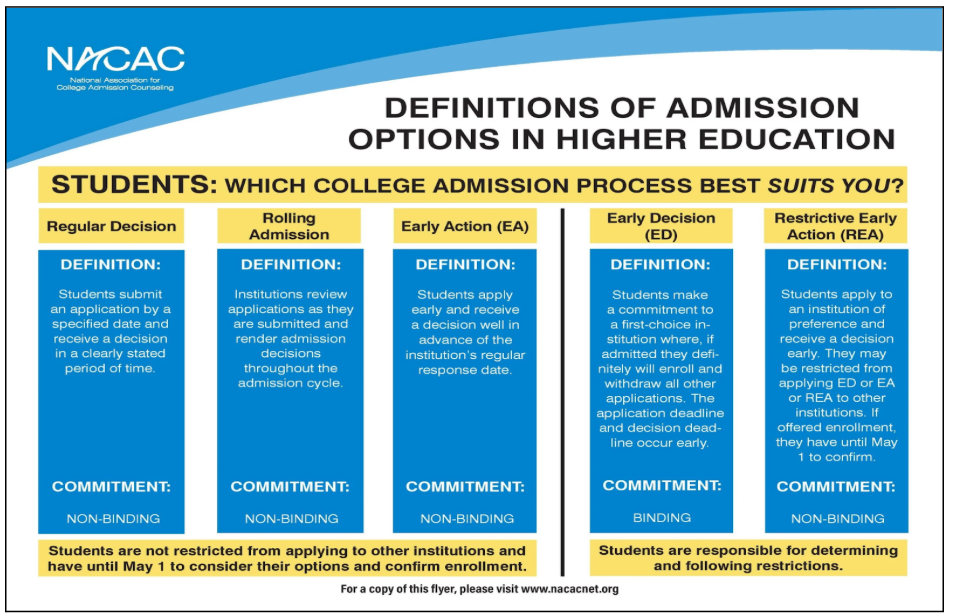
Early Decision is the most binding early option. This means that if you are accepted to a school under an ED plan, you are committing to attend that school and must withdraw all other applications. Traditionally, ED acceptance rates are higher than those in the regular pool, though this varies by school. ED is ideal for students who have a clear top choice and want to demonstrate strong commitment. Because it’s binding, it’s crucial to discuss finances and other factors with family before applying—price comparison won’t be possible later.
Restrictive Early Action (REA)
Restrictive Early Action is a non-binding option traditionally offered by highly selective schools, including Harvard, Stanford, and Yale. If students pursue this pathway, they are restricted from applying early to any other private institutions. However, this plan is still non-binding, meaning that students accepted through REA are not obligated to attend and can still apply to other schools during the regular cycle. This allows time to compare offers and financial aid packages before making a final decision.
Early Action
Early Action applications are non-binding and nearly identical to regular decision applications, except for the earlier deadline and earlier notification. Students accepted through EA have the flexibility to compare offers and decide which school fits them best. Applying early not only provides an early decision but also helps spread out the workload during senior year, hopefully providing some peace of mind in the final months of high school.
You Thought You Were DONE?
Not quite. Once that submit button is pressed, the work isn’t over. Early applicants should begin working on scholarship applications and filling out financial aid forms such as the FAFSA, CSS Profile, and TAP (for New York State residents). And don’t forget that colleges do look at first-semester grades—so please try to keep senioritis in check.
Decision Time!
Most early applications will release decisions between mid-December and late January. Students can be accepted (congrats), rejected (welp), or deferred. A deferral means that the institution has moved your application to the regular decision pool and will review it again later. Note: If you are deferred after applying Early Decision, the binding agreement no longer applies.