

By Salil Karkhanis
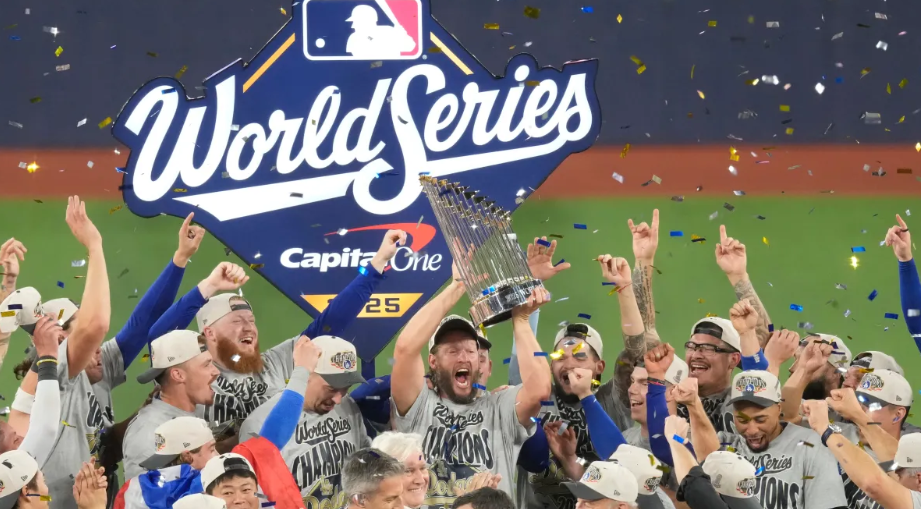
The Los Angeles Dodgers are world champions once again. For the first time since the Yankees ‘ three-peat from 1998 to 2000, baseball finally has a team that went back-to-back. The Dodgers pulled off one of the craziest comebacks in recent memory, beating the Toronto Blue Jays in a seven-game thriller that had just about everything you could ask for. There were blowouts, marathon games, clutch plays, and an ending that felt straight out of a movie.
The series started like a nightmare for Los Angeles. Toronto came out on fire in Game 1, lighting up Blake Snell and the Dodgers for eleven runs in an 11 to 4 beatdown. Addison Barger hit the first pinch-hit grand slam in World Series history, and Alejandro Kirk added a two-run homer in the same inning. Daulton Varsho tied the game earlier with a two-run shot, and the Rogers Centre crowd went crazy. Shohei Ohtani hit a late homer, but it barely mattered. Toronto fans were chanting “We don’t need you!” every time he stepped to the plate. For a moment, it looked like the Blue Jays were about to run away with it.
But the Dodgers did not panic. They bounced back in Game 2 behind Yoshinobu Yamamoto, who threw a complete game to even the series with a 5 to 1 win. Mookie Betts drove in runs, the bullpen finally got rest, and the Dodgers looked like themselves again. That set the stage for what might go down as one of the greatest World Series games of all time.
Game 3 was insane. It lasted eighteen innings, six hours and thirty-nine minutes of pure tension. Both bullpens were drained, both teams looked exhausted, and it felt like no one would ever score again. Shohei Ohtani hit two homers that night, while Freddie Freeman came up clutch once again; after nearly seven hours, Freeman crushed a 406-foot home run straight to center field to end it. Dodger Stadium exploded. It was his second career World Series walk-off homer, and it gave Los Angeles a 2 to 1 series lead. That game alone felt like a full season’s worth of emotion.
Then Toronto punched back again in Game 4. After that brutal marathon loss, most teams would fall apart, but not the Blue Jays. Vladimir Guerrero Jr. told his team to keep their heads up and then backed it up by hitting a two-run blast off Ohtani in the third inning. Shane Bieber threw five solid innings, giving up only one run, and the Jays won 6 to 2 to tie the series again.
Game 5 was the night Trey Yesavage became a household name. The 22-year-old rookie struck out twelve Dodgers without walking a single batter, breaking a World Series record that had stood since 1949. Toronto’s offense backed him up early with back-to-back homers from Davis Schneider and Guerrero on the first and third pitches of the game. Guerrero’s homer was his eighth of the postseason, and he was hitting over four hundred for the playoffs. Yesavage went seven innings and only allowed three hits in a 6 to 1 Toronto win. The Blue Jays took a 3 to 2 series lead heading home, one victory away from their first title since 1993. Everyone thought it was over.
But then Game 6 happened. The Dodgers held a 3 to 1 lead in the ninth, and the Jays were threatening with runners on base. Andrés Giménez hit a sinking liner to left that looked like it would tie the game. Kiké Hernández sprinted in, lost the ball in the lights, and somehow still made the catch while on the run. Without even hesitating, he fired a one-hop throw to second base to double up Addison Barger and end the game. It was the first game-ending double play by an outfielder in postseason history. The Dodgers had just saved their season with one of the most unbelievable plays ever. Tyler Glasnow, who had just come in for the save, threw his hands in the air as the Dodgers mobbed Hernández. The Blue Jays looked stunned, and for the first time, the pressure started to shift back to them.
Then came Game 7, and it was everything a fan could want. Toronto jumped out early when Bo Bichette crushed a three run homer to center off Shohei Ohtani in the third inning. The crowd was roaring, and Ohtani only lasted two and a third innings, giving up three runs on five hits. Max Scherzer pitched four and a third innings of one run ball for Toronto, but the Dodgers never went away. Will Smith doubled and scored on a sacrifice fly, Tommy Edman brought in another run, and Max Muncy’s solo homer in the eighth made it 4 to 3.
The Blue Jays added a run to stay ahead, but everyone could feel the Dodgers creeping back in. Then, with one out left in the ninth inning and the Dodgers down by a run, Miguel Rojas stepped up and hit the biggest home run of his life. A solo blast that tied the game at four and completely flipped the energy. The Dodgers bench went crazy. Suddenly, it felt like they were meant to win.
From there, Yoshinobu Yamamoto, on literally zero days of rest, came in and put on a show. He entered in the ninth with the bases loaded and got out of it somehow. Then he threw two more scoreless innings, running entirely on adrenaline. Finally, in the top of the eleventh, Will Smith crushed a go-ahead home run that silenced the entire stadium. Yamamoto went back out for the bottom of the inning, gave up a leadoff double to Guerrero, but somehow managed to force a double play to end it. The Dodgers stormed the field as blue and white confetti filled the air.
Looking back, it feels unreal how much happened in one week. The Blue Jays gave everything they had. Guerrero hit eight postseason homers, Yesavage became a star, and their fans were incredible. But the Dodgers refused to die. They were down 3 to 2 in the series and won two straight elimination games on the road. They had historic performances from Freeman, Smith, and Yamamoto, and they showed the toughness that separates good teams from legendary ones.
For the first time in twenty five years, Major League Baseball has a repeat champion. The Los Angeles Dodgers are officially building a dynasty. And if this World Series proved anything, it is that this team never quits.