

By Naman Kapoor
The 2025 Qatar Grand Prix produced one of the most dramatic and consequential races of the Formula 1 season, reshaping the championship narrative and setting up a season finale at Abu Dhabi that promises unprecedented tension. Max Verstappen delivered a masterclass performance to win the race, cutting into the previously comfortable lead of Lando Norris and dramatically reshuffling the title standings. Oscar Piastri, who had looked poised to challenge McLaren teammate Norris for the championship, also saw his hopes adjusted by strategic missteps during the race. What was shaping up to be a relatively straightforward championship for Norris has now transformed into a nail-biting, three-driver showdown.
Piastri started from pole position after a strong sprint race performance, leading the early laps of the floodlit Lusail International Circuit with Norris running alongside him. Verstappen started third but quickly demonstrated his pace advantage, maintaining a close position behind the McLarens. Everything appeared to be going according to McLaren’s plan until a collision between two midfield cars triggered a safety car on lap 7. This incident proved pivotal. Most teams took the opportunity to pit their drivers, but McLaren made the controversial decision to keep both Piastri and Norris out on track. This strategy decision proved costly. Verstappen, who pitted during the safety car period, emerged with a fresh set of tires and the tactical advantage needed to challenge both McLarens over the remaining distance of the race. This sequence of events marked the turning point that allowed Verstappen to seize the initiative and ultimately win.
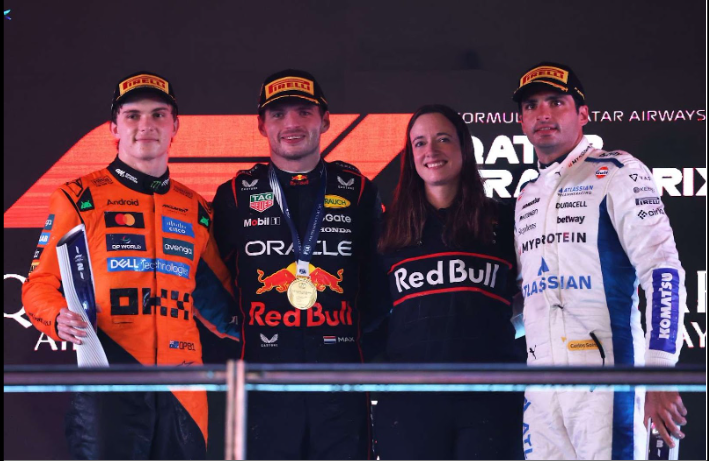
From there, Verstappen managed his tires and pace with precision, methodically overtaking Piastri and creating a gap that he would maintain to the finish. Piastri eventually pitted, rejoining in second place, while Norris struggled after his own stop, becoming trapped behind slower cars and ultimately finishing fourth. Carlos Sainz Jr., in a strong drive for Williams, capitalized on the chaos to finish third, further complicating the title picture. Verstappen crossed the line nearly eight seconds ahead of Piastri, claiming his seventh victory of the season. This win reduced Norris’s championship lead from 24 points to just 12, with Piastri sitting 16 points behind Norris. All three title contenders now have seven wins each this season, setting the stage for an unprecedented final race at Abu Dhabi.
The implications of this result are profound. For Verstappen, the win is not just a points gain but a psychological statement. His season had earlier seen him trail by over 100 points behind the championship leader. With his Qatar victory, he has reasserted himself as a contender and now has the momentum to challenge for the title. For Norris, the Qatar GP exposed vulnerabilities in McLaren’s strategy execution under pressure. A lead that once appeared secure has been reduced to a narrow margin, forcing him to approach Abu Dhabi with heightened focus and composure. Piastri, meanwhile, retains a mathematical chance at the championship, but his path is the narrowest, requiring almost perfect execution and errors from both Verstappen and Norris.
Heading into Abu Dhabi, the stakes could not be higher. With a maximum of 25 points available, each driver has distinct scenarios under which they can claim the 2025 World Drivers’ Championship. Norris, as the current points leader, has the most straightforward path. A podium finish in Abu Dhabi will secure him the championship regardless of how Verstappen or Piastri perform. If Norris finishes fourth or fifth, he remains in contention but risks losing the title if Verstappen wins the race. A finish of sixth or lower leaves him dependent on both Verstappen and Piastri performing below their potential.
Verstappen’s most likely path to the championship is a victory at Abu Dhabi combined with a finish outside the top three for Norris. A second-place finish could also suffice if Norris finishes poorly and Piastri does not win, while a third-place finish requires an almost impossible combination of Norris finishing ninth or lower and Piastri finishing outside the top positions. Verstappen’s resurgence demonstrates his ability to capitalize on opportunity, and Abu Dhabi will demand that he converts his speed and experience into both points and strategic advantage.
Piastri faces the most difficult path. To claim the championship, he needs to win the race, while Norris finishes sixth or lower and Verstappen finishes behind him. In an alternate scenario, a second-place finish combined with Norris finishing tenth or lower and Verstappen finishing fourth or worse could allow him to take the title, though this scenario is extremely unlikely. Piastri’s challenge underscores the narrow margins of championship contention in modern Formula 1 and emphasizes the importance of both driver skill and team strategy.
Beyond the numbers, the Qatar Grand Prix highlighted how a single race can dramatically alter the trajectory of a championship. Strategic decisions, split-second reactions to safety car periods, tire management, and overtaking opportunities all combined to create a race with lasting significance. Verstappen’s victory is a testament to his resilience and ability to perform under pressure, turning a deficit of over 100 points earlier in the season into a genuine championship opportunity. McLaren’s miscalculation, conversely, demonstrates how even dominant teams can falter when under unexpected circumstances.
As Abu Dhabi approaches, the focus will shift to strategy, pit stop execution, tire management, and mental composure. Each of the three contenders brings a unique challenge to the finale: Verstappen seeks redemption and victory after clawing back from a deficit; Norris must defend a slim lead and avoid mistakes; Piastri must exploit any opportunity to overturn the odds. Every action in Abu Dhabi will carry immense weight, as the title may ultimately be decided not by a single driver’s speed alone, but by the complex interplay of performance, strategy, and timing.
The 2025 season finale promises to be one of the most exciting in recent F1 history. Qatar has set the stage for a championship where uncertainty reigns, three drivers have realistic chances of winning, and any outcome remains possible. Fans, teams, and drivers alike are preparing for a high-stakes Abu Dhabi Grand Prix, where the 2025 World Drivers’ Championship will be determined. Every lap, every pit stop, and every decision will matter, making it a finale that F1 enthusiasts will remember for years to come.