

By William Ludwig
Following the emotional powerhouse that was Before Your Eyes, Goodnight Universe had some insane expectations to meet. As one of my favorite indie games—and easily one of the most heart breaking pieces of media I’ve ever experienced—Before Your Eyes left a lasting impact that few games have managed to replicate for me. When it was announced that the developers would be returning with a new project, it was hard not to wonder if lightning could strike twice, or if it would simply live in the shadows of its predecessor.
One of the first things that immediately stands out in Goodnight Universe is its narration, delivered by Lewis Pullman. Coming off a strong performance earlier this year(Thunderbolts*), Pullman brings a quiet, grounded presence to the game that perfectly matches its tone. His narration carries a subtle emotional weight, never overpowering, but always guiding the player through the story in a way that feels calming and reflective rather than forced—adding another layer to an already emotionally driven narrative.
From a gameplay perspective, Goodnight Universe builds directly on the foundation laid by Before Your Eyes, expanding its interactive mechanics in ways that fit the story and bring something new to the game—making it more immersive and dynamic. This mechanic is the game’s facial tracking which was the crux of the first game. In Before Your Eyes, a webcam would track your eyes, watching for when you blink. This was due to the story of the game being about the player’s journey in the afterlife as they relive their memories—and with each blink, you jump forward in time, could be seconds, could be years—making for an interactive fight to stay awake in order to consume as much information as possible which trying to progress the story. On top of the depressing themes of the first game, this mechanic only made it worse by forcing your eyes open, so if the story didn’t make your eyes water, the gameplay made sure to do it for you. In Goodnight Universe, this mechanic is expanded to be able to track your entire head. Multiple times in the story players are asked to close their eyes and move their head around until they find a certain frequency in order to progress. Blinking still remains a mechanic, but here it’s turned into a power, being used to complete tasks and interact with players’ environments.
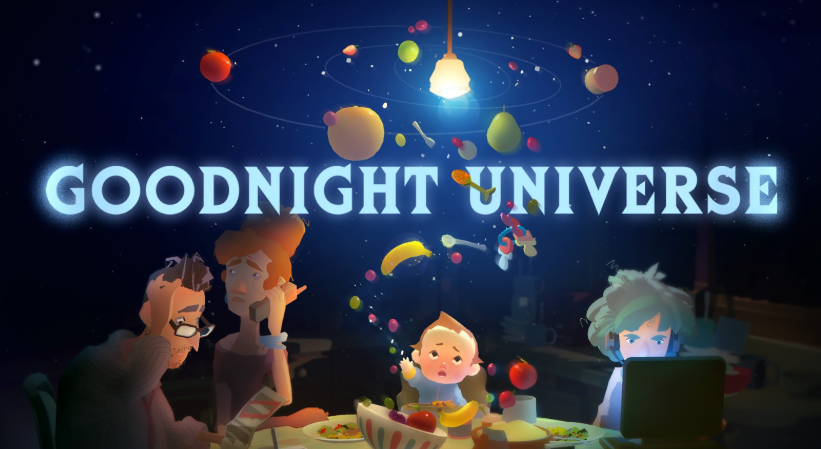
The plot follows a baby named Isaac as he discovers his telekinetic abilities and extreme levels of intelligence at such a young age. As the game progresses, Isaac searches for where he came from, what he actually is, and why he’s able to move things with his mind, all while forming a stronger bond with his family. At its core, Goodnight Universe is deeply heartfelt. However, unlike Before Your Eyes, which was often gut-wrenching and emotionally overwhelming, Goodnight Universe takes a noticeably different approach. It leans more into warmth and wholesomeness focusing on connection, trust, and the quiet struggles within families. The emotional moments are still there, but they feel softer—less about breaking the player down and more about building something meaningful. This shift helps the game stand on its own, distinguishing itself while maintaining the emotional DNA of its predecessor. The themes of family trust and relational difficulty feel especially grounded and relatable. Rather than presenting exaggerated drama, the game explores these ideas in a way that feels real—sometimes uncomfortable, sometimes uplifting, but always honest—keeping the player invested, even during the quieter moments.
Visually, Goodnight Universe also sets itself apart. In a gaming landscape increasingly dominated by hyper-realistic graphics and technical showcases, its unique art style feels refreshing. It embraces a more stylized and expressive aesthetic that completes its emotional tone. The result is a world that feels personal and distinct, reinforcing the idea that not every game needs cutting-edge graphics to leave a lasting impression.
That being said, it’s hard to ignore the inevitable comparison: Goodnight Universe doesn’t quite reach the same emotional, immersive, or memorable heights as Before Your Eyes. The impact isn’t devastating, the moments don’t linger quite as long, and the overall experience doesn’t hit with the same force. But that doesn’t make it a dissapointment—it simply means it took a different path, after all, these two games are completely different in their story, gameplay, and themes. And honestly, that might be its greatest strength. Instead of trying to outdo its predecessor, Goodnight Universe chooses to evolve. It offers a more hopeful, more comforting experience while still delivering a meaningful story and engaging gameplay. It may not redefine the emotional gaming landscape the way Before Your Eyes did, but it doesn’t need to. Overall, between its unique style, mechanics, and story, Goodnight Universe sits at an 8/10 for me personally.