

By: Jessica A. Dennehy
The French, when attempting to overthrow a government, have a history of enthusiasm: between skyrocketing bread prices and the patent of the guillotine, Robespierre and the Reign of Terror are certainly well-remembered in history textbooks. So, as the nation’s debts once again cripple the masses, so too have the mass protests. Across France, police are clashing with demonstrators, buses are being set on fire, and prime ministers are being forced out of parliament at a record rate.
In the last year, France has cycled through a total of three prime ministers: Michel Barnier (September 5th, 2024—December 13th, 2024) with a tenure of 99 days, François Bayrou (December 13th—September 9th, 2025) with a tenure of 270 days, and now Sébastien Lecornu (September 9th, 2025—present). Michel Barnier resigned after he lost support from parliament; Bayrou fell in a confidence vote after attempting to push €44 billion in cuts, which included a spending freeze and sacrificing two public holidays. As Lecornu acclimates to his new position as PM, critics have compared his appointment to a “baptism of fire.”
Firstly, Lecornu needs to dig France out of its record-breaking gross national debt. At the end of the last fiscal year, it reached 114% of GDP—€3.35 trillion. With prior budget slashes unfairly targeting the working class, voters struggling with high tariffs and rising inflation are in dire need of a solution. However, even as he struggles with the nation’s debt, Lecornu has an even more pressing concern: the French population.
For reference, the French government is held directly accountable to the French parliament. Members are able to be voted out if they lose political support. As such, a confidence vote serves as a test, determining whether or not current lawmakers are willing to back the sitting PM and their cabinet. If the vote fails, the PM is forced to assign, and the president, in this case Emmanuel Macron, will appoint a replacement. French President Macron, despite his party lacking a parliament majority, will remain in power until 2027, even if the government he sets up falls annually to the parliament’s whims. With his latest appointment of Lecornu, his trusted ally and the former defense minister, Macron retains power at the risk of creating a “revolving-door” leadership. And voters are enraged—at Macron, but also at Lecornu,
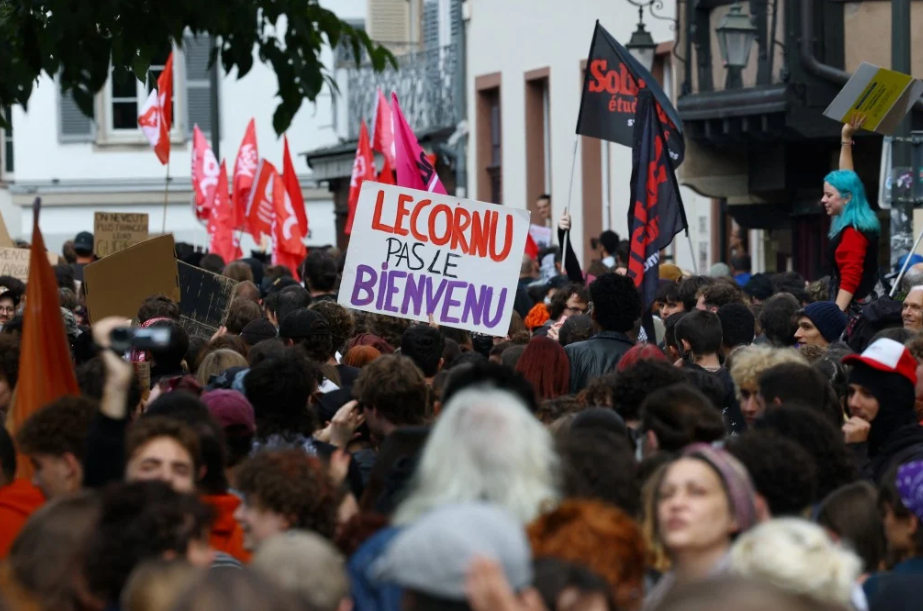
With his latest reshuffling of the French cabinet, the day following Lecornu’s appointment, demonstrators began blocking major roads, building barricades, and setting miscellaneous items on fire. To combat the chaos, 6,000 officers were deployed in Paris alone, equipped with tear gas. Throughout the country, 80,000 officers were deployed, with 473 arrests ultimately made. Nearly 100 schools were reported disrupted, according to the Education Ministry, with 27 being blockaded. Compounding the distractions of school, many French youth joined these marches, potentially building momentum for further demonstrations in the following weeks.
A 29-year-old demonstrator named Anna reported to CNN that “We’re angry; we’re very angry.” She asks, “What’s the point in voting? We feel like the government isn’t listening to us.”
For Lecornu to last longer than his predecessors, he’ll have to face a variety of challenges: stabilizing an unfriendly parliament, combating the French national debt, and rebuilding public trust. Failure means pushing France deeper into crisis. With debt climbing and protests mounting, the question is no longer whether Macron’s government will bend—it’s how much it can bend before it breaks.