

By Darshini Dayanidhi
Katie Zacharia’s tenure as White House press secretary ended on October 16, five days after she began the position, following a brief first press conference that drew scrutiny over her delivery, limited engagement with reporters and professional background. Her departure came after President Donald Trump publicly expressed uncertainty about whether she should remain in the role, despite initially praising her performance.
Zacharia was appointed by Trump on October 9 to replace Karoline Leavitt, who left the position in August. Before joining the White House, Zacharia worked for Trump Media, the company behind Truth Social, and briefly served as a spokesperson for the Department of Homeland Security. She had also appeared on conservative television networks as a political commentator.
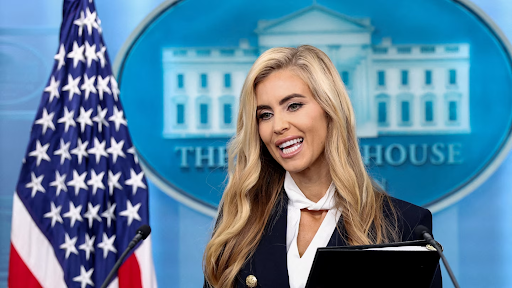
Her first press briefing, held on October 13 in the James S. Brady Press Briefing Room, lasted approximately 14 minutes. Around eight minutes were devoted to prepared remarks praising Trump’s policies and administration. When the opening statement concluded, Zacharia took questions from only three reporters, representing Breitbart News, Fox News and the Daily Mail. The limited question-and-answer session became a central point of criticism following the appearance.
During her opening remarks, Zacharia read from a prepared script while frequently looking down at her briefing notes. Her delivery attracted criticism online, with viewers questioning her readiness for the position. The briefing offered little opportunity for reporters to ask follow-up questions or seek clarification on the administration’s positions.
One exchange concerned whether the United States had stopped sharing intelligence with Ukraine. Zacharia did not provide a direct answer, telling the Fox News reporter, “I’ll have to get back to you on that.” She did not elaborate before moving on.
Another exchange drew attention for a different reason. A reporter asked how Zacharia planned to balance the demands of the position with raising four children, particularly after Leavitt had left the role to spend more time with her family. Zacharia spoke about her husband and children, explaining that family remained a priority.
During the answer, she mistakenly referred to her husband as “my president” before correcting herself.
“So my president, excuse me, my husband,” Zacharia said, then added, “That’s a good one.”
The remark circulated widely online. Although Zacharia immediately corrected the statement, the verbal slip became one of the most widely discussed moments from the briefing, adding to criticism of an appearance already marked by its short question period and reliance on prepared remarks.
The briefing prompted criticism from political journalists and former White House communications officials. Online reactions focused on Zacharia’s delivery, her dependence on the script and the decision to end the briefing after only three reporters had asked questions. The White House, however, defended the debut. Trump told reporters that Zacharia had done “very good,” while communications director Steven Cheung described her as a qualified addition to the administration.
Questions about Zacharia’s legal credentials soon became a more serious source of scrutiny. Trump had introduced her as an attorney when announcing the appointment, and Zacharia had repeatedly described herself as a lawyer in television appearances and on social media. Her professional biography also referenced legal work, including a position as general counsel for Fix California.
Zacharia graduated from Pepperdine University’s law school in 2011. However, an investigation by The Wall Street Journal and subsequent reporting by other news organizations found that she had not passed a U.S. state bar examination. She later confirmed that she had taken the California bar exam, but failed and had never retaken it.
The admission raised questions about her repeated use of the title “lawyer” and Trump’s description of her as an attorney. In the United States, graduating from law school does not, by itself, authorize a person to practice law. Admission to a state bar is generally required to provide legal services as a licensed attorney.
Zacharia addressed the controversy in interviews with conservative media outlets on October 15. She explained that she had planned to move to China with her husband after graduating from law school and considered the California bar results unimportant because she did not expect to practice law in the United States. She also said she had worked in international transactional law while living in Beijing.
Rather than deny that she had used the term “lawyer,” Zacharia defended the distinction she said she had been advised to make between a lawyer and an attorney. She said she had consulted people in the legal profession who told her that her law degree and international legal experience allowed her to describe herself as a lawyer, while advising her against using titles such as “attorney at law” or “Esquire.”
“I was very careful how I executed this,” Zacharia said in an interview with conservative commentator Jack Posobiec. “I never came across as someone who was an attorney at law.”
However, her explanation faced further scrutiny because records of previous public statements showed that she had described herself as an attorney on multiple occasions. In an April appearance on Fox News, she had said she lived in Beijing as a corporate lawyer for three years. Her Instagram biography also identified her as a lawyer, while Trump’s announcement described her as an attorney.
The distinction she drew between the two terms was disputed by legal experts. Several attorneys and law professors told news organizations that the terms are commonly used interchangeably and that a law degree alone does not authorize someone to present themselves as licensed to practice law. The debate extended beyond her choice of terminology to questions about her previous legal work and whether her public descriptions accurately conveyed her qualifications.
The controversy also prompted formal complaints seeking an investigation into whether Zacharia’s descriptions of her credentials violated California law. The complaints did not establish that a violation had occurred, and the questions surrounding her use of the titles remained subject to legal scrutiny.
The White House defended Zacharia’s background, maintaining that she had worked in international transactional law with appropriate credentials. Cheung also criticized the organization that filed one of the complaints, rejecting its allegations against the former press secretary.
On October 16, Trump expressed uncertainty about Zacharia’s future in the position. Her departure was confirmed later that day, ending her tenure after five days. As of October 20, the administration had not publicly announced a permanent successor.
Zacharia’s brief tenure was marked by a short first briefing, a limited number of questions, a widely circulated verbal mistake and growing scrutiny of her legal credentials. Her departure leaves the administration facing another change in its communications team as the November midterm elections approach.